Why it mattersWalking works best when you can see it adding up.
Walking is one of the easiest kinds of activity to keep up every day, and research reviews find that exercise combined with changes to what you eat leads to more weight loss than diet alone. The hard part is staying consistent long enough to see results.¹ ²
Steply makes the walking side concrete: a step goal tied to your target, a healthy range to aim for, and a trend that connects your weigh-ins to the steps you actually took.
A number to aim for
An estimated daily step goal toward your target weight, set in one tap.
Honest estimates
Clear about the assumptions, and about real-world loss usually being slower.
Progress you can trust
A weight trend that shows the steps behind each change.
Weight loss step calculatorA step goal built around your target.
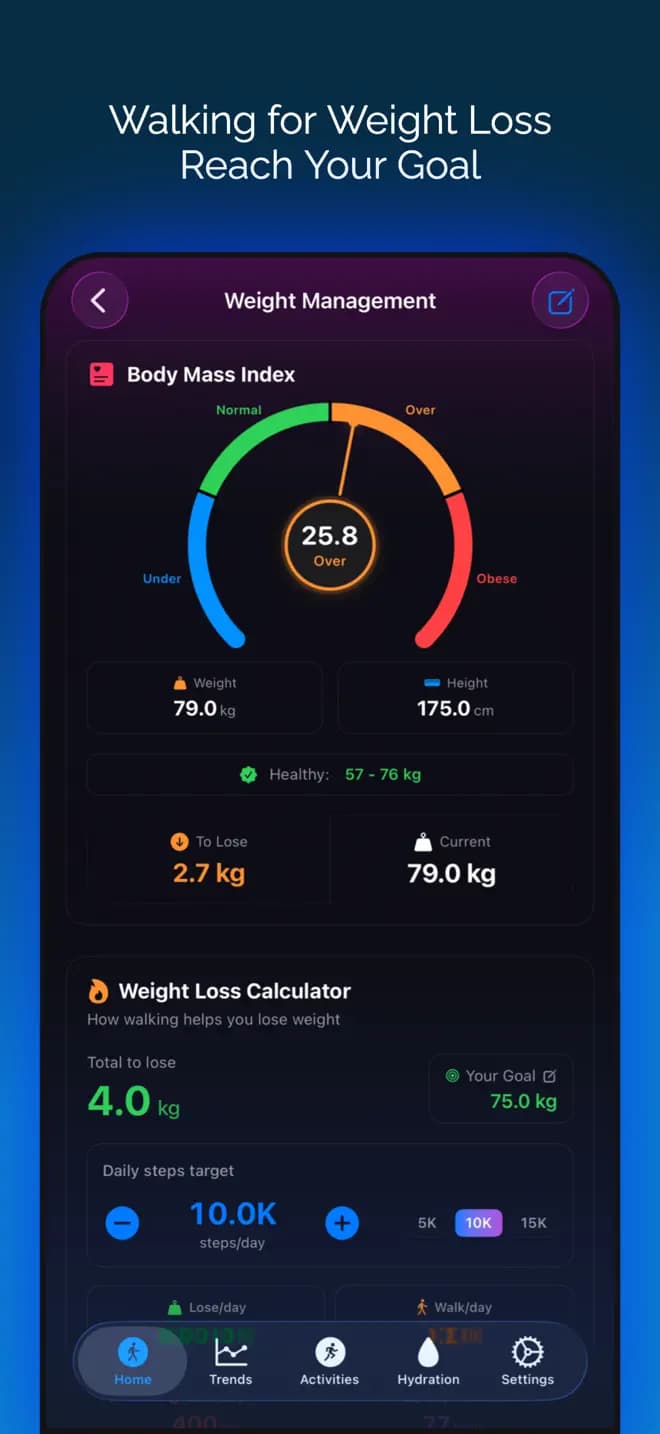
Add your height and weight and Steply's Weight Loss Calculator shows your healthy range and how much there is to lose. Choose a daily step target, with quick picks for 5,000, 10,000 and 15,000 steps, and it estimates the calories you'd burn, the weight you'd lose and the distance you'd walk each day, plus the days to reach your goal.
Like the target? Tap Set as Goal and it becomes your daily step goal on Home, your widgets and Apple Watch.
Your weight
Current weight, target weight and how much there is to lose.
Daily estimates
Calories, weight and distance per day for the step target you choose.
Days to goal
How long your chosen step target would take at that pace.
How the weight loss estimates are calculatedEstimates, explained honestly.
The calculator uses common rules of thumb: about 7,700 calories per kilogram (3,500 per pound) and roughly 0.04–0.05 calories per step, depending on your weight. That makes it a useful planning tool, not a prediction.
In practice, weight usually comes off more slowly than these simple rules suggest, because your body adapts as you lose weight.³ Food matters too, and so do hydration, sleep and muscle. Treat the numbers as a starting point, and let your weight trend tell you how it's really going.
Weight trend and the steps between weigh-insSee what's actually working.
Weight Trend plots your weigh-ins over time with your total change and weekly rate. The Steps → Weight Journey view shows the steps you walked between each pair of weigh-ins, your average steps per day, and roughly how many steps went into each kilogram or pound lost.
Steply is upfront about what a trend can and can't tell you: weight also shifts with hydration, food, muscle and time of day, so weigh in at a consistent time, and remember that trends show correlation, not causation.
Healthy weight range for your heightA healthy range, built in.
Steply shows your healthy weight range from your height (a BMI of 18.5 to 24.9) and lets you know if a target falls outside it. If you're already in the healthy range, it tells you so, and if you're below it, it suggests gaining rather than losing. BMI is a simple screening measure, so talk to your doctor about the right target for you.
Other Steply features that support weight lossEverything else that helps.
Weight loss is a long game, and the rest of Steply is built for consistency.
Step counter & streaks
A live goal ring and a streak that never breaks before midnight.
GPS walks
Record walks with distance, pace, calories and elevation, saved to Apple Health.
Interval Walking
Three minutes fast, three minutes slow, for a brisker 30-minute walk.
Water tracking
An automatic water goal that adds a little extra on days you walk more.
Questions about walking for weight loss
How many steps a day should I walk to lose weight?
There's no single number. A common starting point is the CDC's recommendation of at least 150 minutes of moderate activity a week, such as brisk walking. Steply's calculator estimates a daily step target toward your own target weight, and walking works best combined with changes to what you eat.
How does Steply estimate weight loss from steps?
It uses common rules of thumb: about 7,700 calories per kilogram (3,500 per pound) and roughly 0.04–0.05 calories per step depending on your weight. These are planning estimates, not predictions.
Why am I losing weight more slowly than the estimate?
That's normal. Research shows the body adapts as weight comes off, so real-world loss is usually slower than simple calorie rules suggest. Food, water, sleep and muscle also affect the scale.
Does Steply track my weight?
Yes. Steply reads your weight from Apple Health, lets you add weigh-ins, and plots your weight trend with the steps you walked between each reading.
Is it safe to lose weight by walking?
Walking is a gentle, low-impact activity for most people, but if you have a health condition or a lot of weight to lose, talk to your doctor about a plan that's right for you.
Sources
- Shaw K, Gennat H, O'Rourke P, Del Mar C. Exercise for overweight or obesity. Cochrane Database of Systematic Reviews. 2006;(4):CD003817. PubMed
- Centers for Disease Control and Prevention. Physical Activity and Your Weight and Health. CDC
- Hall KD, Sacks G, Chandramohan D, et al. Quantification of the effect of energy imbalance on bodyweight. The Lancet. 2011;378(9793):826–837. PubMed
This page is general information, not medical advice. Talk to your doctor before starting a weight-loss plan, especially if you have a health condition.
Works well with.
Step Counter & Goals
Live step count, a daily goal that fits you, streaks, 39 achievements and timely nudges.
Learn more ›Insights & Analytics
Consistency Score, activity clock, hourly patterns and side-by-side comparisons across weeks, months and years.
Learn more ›Water Tracking
An automatic water goal that adapts to your walking, reminders you can log from, and one-tap logging on widgets and Apple Watch.
Learn more ›